Operational Handbooks

Participants in the guideline development process

The following contributed to the writing of this manual:

Christopher Gilpin (Lead), Jean Iragena, Fuad Mirzayev, Wayne van Gemert, Karin Weyer

The following participated in the joint CDC–WHO International Technical Consultation on Laboratory Biosafety, 2–4 September 2008, Atlanta, GA, USA:

May Chu, Daniela Cirillo, Philippe Dubois, Christopher Gilpin, Paul Jensen, Shanna Nesby, Nicoletta Previsani, John Ridderhof, Thomas M Shinnick, Veronique Vincent, Karin Weyer.

Executive summary

Following a technical consultation held between the World Health Organization (WHO) and the United States Centers for Disease Control and Prevention (CDC) in Atlanta, GA, in September 2008 on strategies, approaches and partnerships that could be implemented to improve laboratory biosafety worldwide, an Expert Group meeting was convened at WHO’s Headquarters in Geneva, Switzerland, in April 2009 to elaborate guidance on biosafety related to laboratory procedures for diagnosing tuberculosis (TB). Members of the Expert Group submitted Declarations of Interest.

3. Environmental controls

Environmental controls are the second pillar of the triad of IPC measures and should be implemented in combination with other TB IPC measures. The aim is to reduce the concentration of infectious particles in the air through a mix of interventions for dilution, removal, filtration or disinfection.

Annex 10. Country example: education messages for tuberculosis and for tuberculosis infection prevention and control

This annex provides examples of posters from Myanmar with educational messages for tuberculosis (TB) and TB infection prevention and control (IPC) for community members.

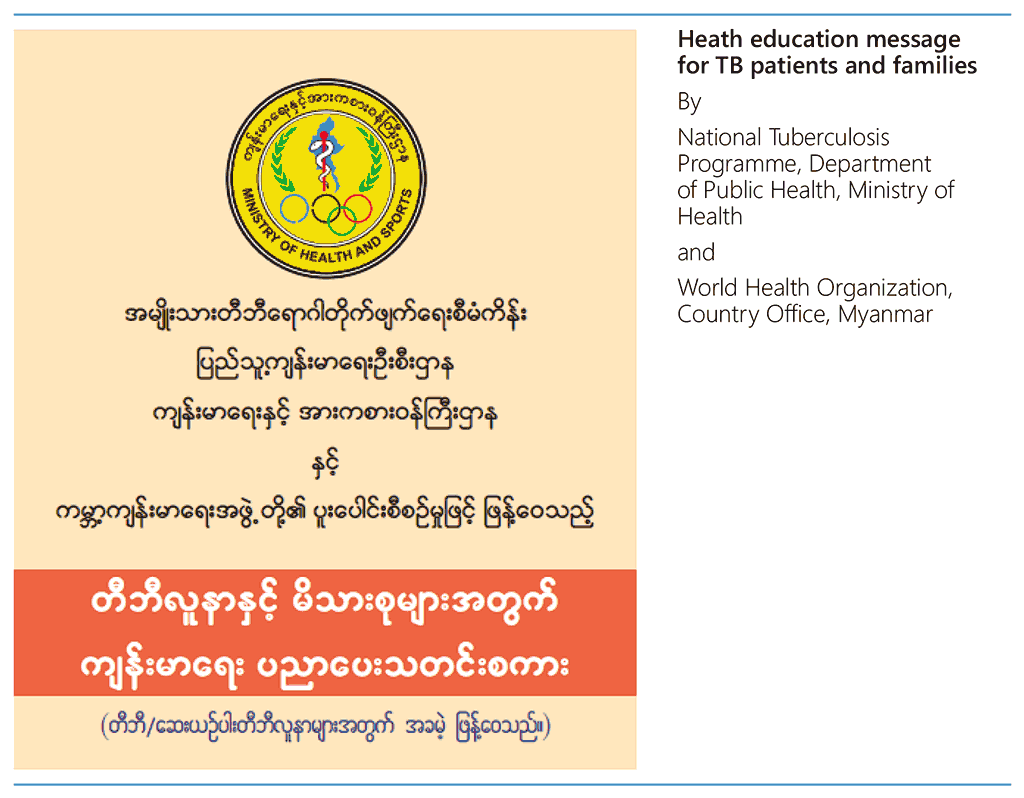
Heath education message for TB patients and families

By National Tuberculosis Programme, Department of Public Health, Ministry of Health and World Health Organization, Country Office, Myanmar

1

Annex 9. Checklist for the review of programmatic implementation of tuberculosis infection prevention and control

This checklist was prepared for the express purpose of national tuberculosis (TB) programme reviews for TB infection prevention and control (IPC) (1,2). Such reviews typically consider multiple programmatic components; thus, a checklist helps the reviewer to focus on the critical areas of any particular component.

Objectives

Annex 8. Choosing a radiometer for measurement of ultraviolet C irradiation

The manufacturer’s specifications should be checked to determine whether the radiometer has the appropriate characteristics for wavelength, irradiance measurement and accuracy, based on the ultraviolet C (UVC) source being used (1)

Wavelength range

The radiometer chosen should be able to measure wavelengths of 220–280 nm with a peak response at 254 nm for standard UVC254 low-pressure mercury lamps.

Annex 7. How to choose upper-room germicidal ultraviolet light fixtures

The scenarios in this annex are designed to aid in choosing the most appropriate and cost-effective germicidal ultraviolet light features; that is, features using ultraviolet C (UVC) to create an effective upper-room UVC254 system. The effectiveness of the system depends on room shape and dimensions, type of fixtures available and how occupants will use the space. The three examples given demonstrate how these factors can influence final fixture choices for upper-room UVC (1).