Retour
In 2023, an estimated 10.8 million people fell ill with tuberculosis (TB), among whom 1.25 million died from the disease (1). Undernutrition is a key risk factor that drives the TB epidemic and each year it accounts for an estimated 0.96 million (95% uncertainty interval 0.4–1.1 million) episodes of TB (1). The prevalence of undernutrition in people with TB is estimated to be 48% (2). People with undernutrition are more than twice as likely to fall ill from TB (3), and to have a higher risk of poor treatment outcomes such as death and loss to follow-up, compared with those who do not have undernutrition (4, 5).
The World Health Organization’s (WHO’s) End TB Strategy includes targets to reduce TB incidence by 80% and TB deaths by 90% by the year 2030, relative to baseline levels in 2015 (6). Addressing comorbidities and the determinants of TB, including undernutrition, is a central component of that strategy. In September 2023, in the political declaration of the United Nations (UN) high-level meeting on the fight against TB, Member States committed to strengthening comprehensive care and integrating within primary health care the systematic screening, prevention, treatment and care of TB and of related health conditions such as undernutrition (7).
The 2013 WHO publication Guideline: nutritional care and support for patients with tuberculosis (8) included recommendations on nutritional assessment and counselling, management of moderate and severe acute malnutrition, micronutrient supplementation for people with TB, and nutritional assessment and support for household contacts of people with TB. Since 2013, there has been new evidence on the relationship between TB and undernutrition, on supplementation with macronutrients and micronutrients for people with TB, and on food assistance to prevent TB among household contacts of people with TB. In 2023, WHO commissioned a series of systematic reviews on nutritional interventions for people with TB and their household contacts, and in June–July 2024, WHO convened a guideline development group (GDG) to review WHO’s recommendations on TB and undernutrition, in light of the available evidence.
The specific objectives of the undernutrition section of this document are to:
- reduce the burden of undernutrition among people with TB; and
- reduce the burden of TB among people with undernutrition and in food insecure settings.
The anticipated impacts are as follows: improved identification of undernutrition in people with TB and their household contacts; improved clinical outcomes in people with TB and undernutrition; reduced TB incidence in households of people with TB in food insecure settings; timely identification and management of TB in people with undernutrition or who experience food insecurity; and reduced out-of-pocket costs relating to nutrition for households of people with TB.
It is envisaged that implementation of these guidelines will contribute to the achievement of the End TB Strategy, to Sustainable Development Goal (SDG) 2 (zero hunger) and SDG 3 (good health and well-being).
The recommendations in this section replace those included in the 2013 guidelines. This document consolidates existing recommendations and new recommendations developed in 2024 on TB and undernutrition. The new, updated and retained recommendations on TB and undernutrition are summarized in Table A.
This section of the guidelines targets policy-makers in ministries of health and social affairs, as well as international technical and funding organizations, researchers, nongovernmental organizations and civil society organizations involved in nutrition, food assistance and social assistance. It is expected that these recommendations will also be used by health professionals, including doctors, nurses, community health workers and educators who provide TB and nutritional care and support in both public and private sectors.
Table A. Recommendations relating to undernutrition in the WHO consolidated guidelines on tuberculosis. Module 6: tuberculosis and comorbidities
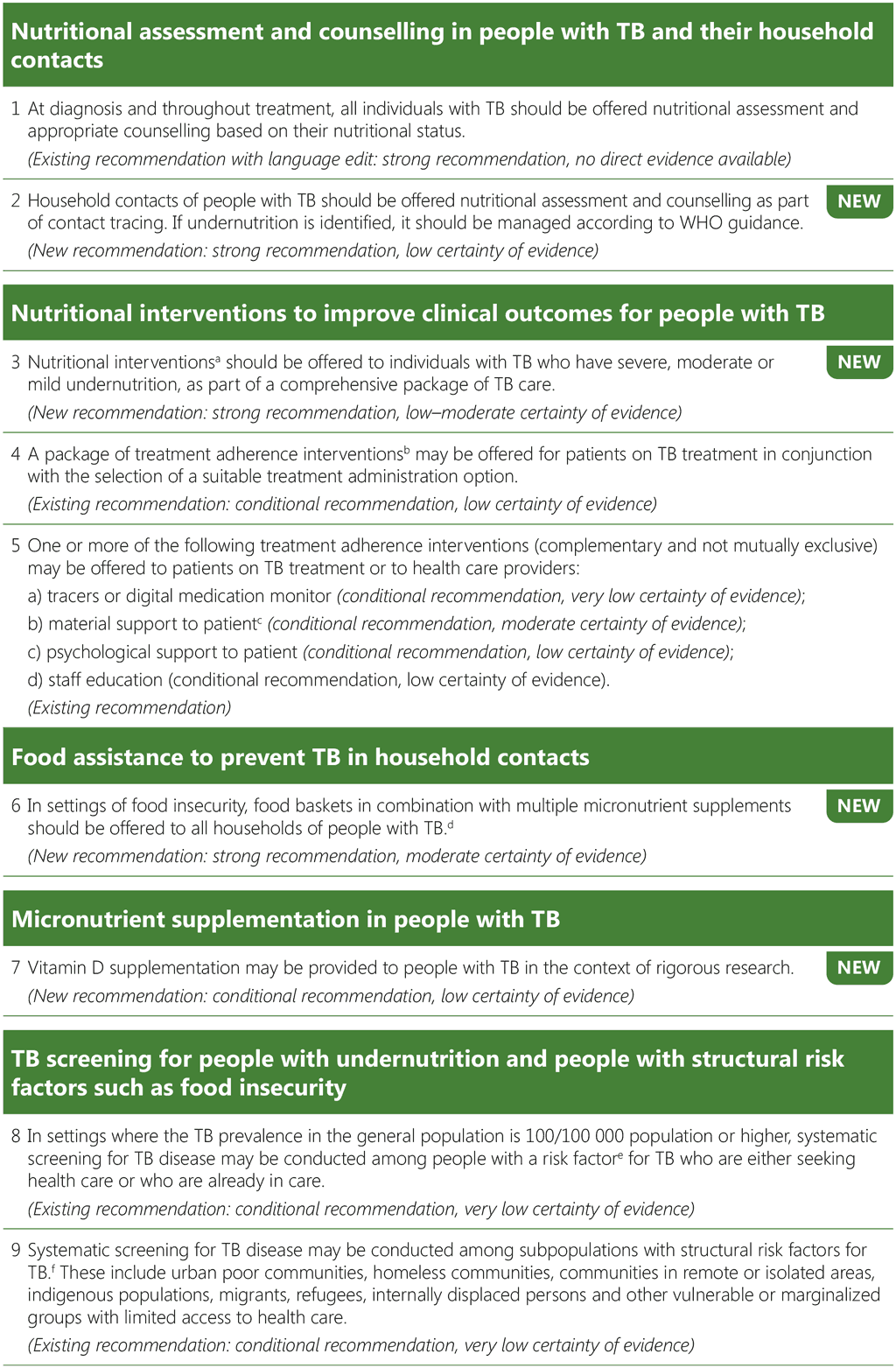
a Examples of nutritional interventions are direct food provision, specially formulated foods and financial support.
b Treatment adherence interventions include social support such as: patient education and counselling; material support (e.g. food, financial incentive and transport fees); psychological support; tracers such as home visits or digital health communications (e.g. SMS, telephone calls); medication monitor; and staff education. The interventions should be selected on the basis of the assessment of the individual patient’s needs, provider’s resources and conditions for implementation.
c Material support can be food or financial support such as: meals, food baskets, food supplements, food vouchers, transport subsidies, living allowance, housing incentives, or financial bonus. This support addresses indirect costs incurred by patients or their attendants in order to access health services and, possibly, tries to mitigate consequences of income loss related to the disease.
d A household where at least one member has been diagnosed with TB; this term also includes the person with TB.
e The source guideline identifies undernutrition as a risk factor for TB.
f Structural risk factors for TB also include food insecurity.
References for Executive summary⁴
- Global tuberculosis report 2024. Geneva: World Health Organization; 2024 (https://iris.who.int/handle/10665/379339). Licence: CC BY-NC-SA 3.0 IGO.
- Li A, Yuan SY, Li QG, Li JX, Yin XY, Liu NN. Prevalence and risk factors of malnutrition in patients with pulmonary tuberculosis: a systematic review and meta-analysis. Front Med. 2023;10:1173619 (https://doi.org/10.3389/fmed.2023.1173619).
- Franco JV, Bongaerts B, Metzendorf MI, Risso A, Guo Y, Pena Silva L et al. Undernutrition as a risk factor for tuberculosis disease. Cochrane Database Syst Rev. 2024;6:CD015890 (https://doi.org/10.1002/14651858.CD015890.pub2).
- Sinha P, Ponnuraja C, Gupte N, Prakash Babu S, Cox SR, Sarkar S et al. Impact of undernutrition on tuberculosis treatment outcomes in India: a multicenter, prospective, cohort analysis. Clin Infect Dis. 2023;76:1483–91 (https://doi.org/10.1093/cid/ciac915).
- Wagnew F, Alene KA, Kelly M, Gray D. The effect of undernutrition on sputum culture conversion and treatment outcomes among people with multidrug-resistant tuberculosis: a systematic review and meta-analysis. Int J Infect Dis. 2023;127:93–105 (https://doi.org/10.1016/j.ijid.2022.11.043).
- The End TB Strategy. Geneva: World Health Organization; 2015 (https://apps.who.int/iris/handle/10665/331326).
- Political declaration on the high-level meeting on the fight against tuberculosis “Advancing science, finance and innovation, and their benefits, to urgently end the global tuberculosis epidemic, in particular by ensuring equitable access to prevention, testing, treatment and care”. New York, NY: United Nations; 2023 (https://documents.un.org/doc/undoc/gen/n23/306/91/pdf/n2330691.pdf).
- Guideline: nutritional care and support for patients with tuberculosis. Geneva: World Health Organization; 2013 (https://iris.who.int/handle/10665/94836).
4 All references were accessed on 7 May 2025.